

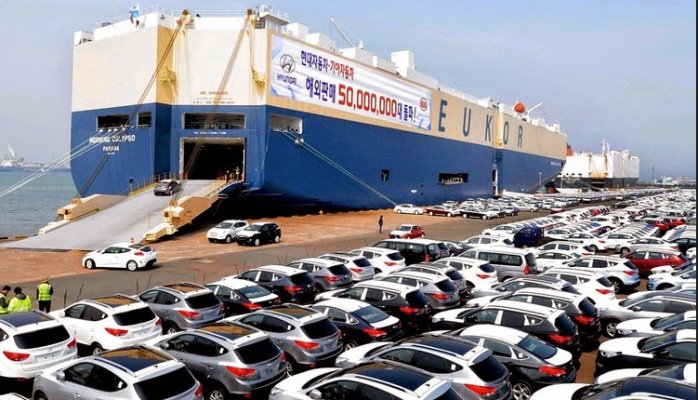
State Bank of Pakistan recently changed the Prudential Regulations for Consumer Financing (PRCF). The meeting was held at the ministry of industries and production, Islamabad.
Main Points
Following are the main heads of the new PRCF policy.
1- Proposal:
Imposition of 50 % Regulatory Duty (RD) on import of Electric Vehicles having more than 50 kWh battery pack
Reasoning:
Due to the decrease in Custom Duty (CD) on EVs, in CBU condition, from 25% to 10 %, the import of high-end EVs increasing the current account deficit. The purpose of EV Policy is to promote local manufacturing whereas the import of high-end EVS has increased due to reduction in CD. The said measure will discourage the import of high-end EVs in CBU condition
2- Proposal:
RD On Hybrid Vehicles (CBU) to be increased from 15 % to 50% on 1501 cc to 1800cc Vehicles
RD on CBU import (normal gasoline vehicles) to be increased from 15% to 50%
Reasoning:
the said intervention will discourage the import of vehicles in CBU conditions and will improve the current account deficit.
3- Proposal:
FED on locally manufactured cars/SUV’s from 1500cc and above to be enhanced from 5% to 10%
Reasoning:
FED on CKD manufacturing to be increased for a limited period because of the current financial crunch
Along with the above-mentioned reforms the State Bank of Pakistan has announced that there will be a change in financing the new imported and locally manufactured CBU vehicles. There will be changes in the regulatory requirements that will be tightened for the financing of domestically manufactured vehicles with an engine capacity of more than 1000cc and also there are reforms in other financing facilities like personal loans and credit cards.
PR Policies
Also, there are some changes made to PRs policy. The change in PRs effectively restricts the financing of imported vehicles which means from now onwards there will be no financing of the imported vehicle. There are also some restrictions and strict rules to finance the locally manufactured vehicle with an engine capacity of more than 1000cc
Personal Car Finacing

Following changes have been made in personal car financing,
- Previously maximum financing tenure was 7 years but now it is reduced to 5 years.
- Previously maximum tenure for a personal loan was 5 years which is now reduced to 4 years.
- Maximum dept-burden ratio is reduced to 40% from 50%
- Maximum amount limit for the car financing availed by one person from all banks/DFs in total will not increase from the limit of RS. 3,000,000 at any point or at any time.
- Previously minimum down payment to finance a vehicle was 15% which is now increased to 30%.
These regulations are made by keeping the lower- and middle-income class in mind and these policies will apply to the locally manufactured/ assembled vehicles with an engine capacity up to 1000cc. These do not apply to a locally manufactured electric vehicle to protect the environment.
Summary
This new policy summarizes that a person can only get financing services on a locally manufactured vehicle below 1000cc with a maximum price of 3 million and after giving a 30% down payment for 5 years. A person cannot get any imported vehicle financed.
Impact on Economy

The desperate move and decision of state bank regarding the new Policy of car financing, to reduce import of vehicle and to increasing the demand of domestically produced vehicles, just to maintain the current account deficit which is increased to 2.3 billion USD in July-August from surplus of 838 million USD in last year. and according to them, this step will help to moderate demand growth in the economy and it will lead to lower imports which will give a helping hand to maintain the balance in imports and exports.
The state bank took this decision because, during the first two months of this fiscal year, vehicle imports burst to 495 million USD which was 160 million USD last year. This revision which was made may not have a strong effect on overall import tickets but they will currently increase the sales of locally manufacturing vehicles. Overseas Pakistanis with the current Roshan Account will not be affected by current Vehicle Financing reforms.
Recent developments, however, have proved critics of unparalleled monetary and fiscal stimulus correct. But we can say that ministers are currently very hopeful that these reforms will increase the sale of locally manufacturing units which will ultimately help the economy to get back on track. It is doubt full that the government will overcome the Economic crisis but it may soon don’t have much time if it doesn’t work swiftly to shield its foreign exchange reserves which are based on debts and will come on the same page with the International Monetary Fund in the review if its suspended Programme.