
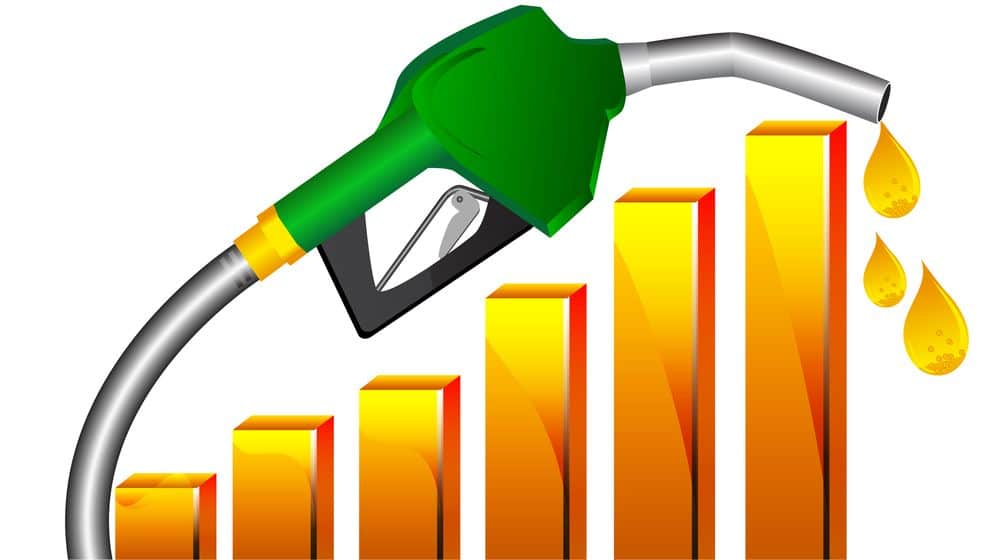
Prices of petroleum products are increasing after every 15 days and there is also a piece of news spreading that petroleum product prices will again increase on the 16th of October, 2021, but this is not confirmed yet. These are not only disturbing the common man but is also a disturbing factor for the government. Currently, the prices of petrol are at PKR 128 per liter and prices of diesel are at around PKR 123 per liter. Govt. should keep this thing in mind that main consumer of the petrol in the middle and lower-middle-class of the population as they are consuming petrol in their bikes, rickshaw, small vehicle and small private transport and same in the case of diesel people are mostly using it in public transport, agricultural machinery, tube-wells, and heavy transport vehicles.
At the start of the fiscal year, it was decided that government will get the revenue of PKR 610 billion from the levy through petroleum products and this target also seems to be in danger and ultimately will affect the budget. Unfortunately, govt is currently under the pressure of the IMF who wants the govt to apply additional taxes in order to overcome the loss of the petroleum levy.
Import Bills
Along with this issue, the import ticket for oil is doubled up, around 103%, which was $1.5 billion in last year, and now it is $3.1 Billion. Crude oil quantity increased by 3.2% but its import value went up by 84% to 820 million USD. The value of LNG is increased 138% and LPG is also increased by 40%.
Fuel Consumption in Pakistan
It is to keep in mind that the consumption of oil is also increasing because industries and transportation are also re-opening and trying to retain their previous position before the Covid-19 lockdowns. Overall fuel consumption is increased about 24% in the first 3 months of the fiscal year and this the highest number since the last quarter of 2018 and at that time it was 6,400,000 million tons. Now the monthly petrol and diesel consumption is 800,000 and 700,000 respectively and this number appears after a growth of 15% and over 25%.
Comparison
With the increase in prices of crude oil in the international market the govt. had to bring down the levy on petroleum and they had to reduce the GST on petroleum products to bring down the pressure of inflation that remained double-digit until a couple of months ago. Govt. is so much in love of publicity as they used to tell that in our neighbor country petrol and diesel prices are PKR 248 and PKR 220 respectively while in Pakistan it is 123 PKR and 148 PKR but they never mentioned the per capita Purchasing Power Parity which is $4,900 in Pakistan and $6,500 in India.
Oil consumption all over the world is increasing again gradually and coming to its previous level which was before the Covid lockdown. The reason behind this is that all workings are coming to their normal routine. Industries are re-opened and international travels are also coming back to their normal routine.
From the start of this year, International Prices of crude oil have increased by almost 32% to $82 per barrel however, USEI Administration predicted an average of $62 in 2021 and $60 in 2022 which is a little bit higher than the IMF prediction of $56 in 2022.
Dilemma
This is interesting that when internationally the prices of crude oil were $147.27 per barrel in 2008 then the prices of petrol were PKR87 and PKR65 and those were the highest. Now, when the prices of crude oil are almost reduced to 50%, the petroleum products prices are moved to almost double the then rates.
What Govt Should Do
It is fact that the government has reduced the tax rates but it is charging PKR 25 in three major taxes. It is charging around PKR 9 as custom duty, PKR 11-13 per liter as GST, and around PKR 5-6 as PL. The original price is about PKR 85-91 per liter without taxes.
The government can give relief to the public by reducing or fully exempting the customs duty and also should not change the prices twice a month. They should consider that reducing prices may result in higher volume and that will definitely increase the revenue through GST and PL.